Es mostren els missatges amb l'etiqueta de comentaris Neurologia. Mostrar tots els missatges

dimecres, 14 de novembre del 2012

Explainer: what is dreaming? In other words: bad sleep equals bad memory


[...] in recent years the role of dreams in cognition has been reinvigorated by the discovery that the two basic modes of sleep – dream (REM) sleep and Slow Wave Sleep (SWS) – play quite different roles in how we recover from the trials and tribulations of wakefulness.

machineslikeus.com // Wednesday, 14 November 2012

In simplistic terms, SWS regulates physical recovery and REM mental recovery.

Starting with rodent studies, depriving animals of REM sleep was associated with impaired learning. The way in which memories are laid down and learning consolidated is profoundly linked to brain activity during dreaming sleep.

More recently, the same phenomena have been observed in human studies – and these have spawned a whole new field of REM sleep research linking the quality and quantity of dream sleep to memory and learning.

Back to the start

Ironically, the story may yet come full circle. While the first generation of “scientific” dream research did not find a simple link between the reported content of the dream and psychological health, the next generation of dream research may well uncover a link, however subtle.

Many of the drugs we use to treat depression have profound effects on REM or dreaming sleep. We know the ways in which depressed patients learn and recall memories is very different to people who are not depressed.

Depressed people are more likely to recall negative events, experiences and emotions, and more likely to forget positive ones. We know that people who do not get enough sleep, especially REM sleep, do not learn as effectively.

The next 20 years promise a very new and exciting period for research into REM sleep.

But if we stand aside from the immediacy of the new technologies of sleep and the “science” of recent dream research we can see some broader patterns repeating in the human history of dreaming.

We are still looking at dreams as a different state of consciousness that merges aspects of sleep and wakefulness. We still see dreams as an aspect of mind and brain that can influence how we see and interpret the world.

We now have sufficient knowledge of genetics to see that our brains carry the seeds of the past and that the ways our brains operate do reflect the collective unconscious – an idea posited by Freud’s famous student, Carl Jung.

We still see dreams as a source of inspiration and a canvas upon which we can create new and different possibilities, new futures.

One can only wonder on how we might understand and use our dreams in another thousand years.

Source: http://machineslikeus.com/news/explainer-what-dreaming/page/0/1

dijous, 25 d’octubre del 2012

Identifying the Brain's Own Facial Recognition System

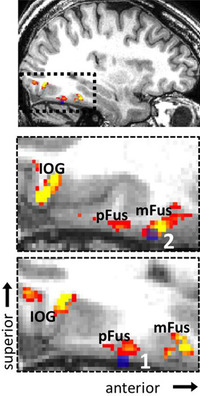
The ability to recognize faces is so important in humans that the brain appears to have an area solely devoted to the task: the fusiform gyrus. Brain imaging studies consistently find that this region of the temporal lobe becomes active when people look at faces. Skeptics have countered, however, that these studies show only a correlation, but not proof, that activity in this area is essential for face recognition. Now, thanks to the willingness of an intrepid patient, a new study provides the first cause-and-effect evidence that neurons in this area help humans recognize faces—and only faces, not other body parts or objects.
Science Now // Elizabeth Norton // 23 October 2012

Well spotted. Two locations in the brain's fusiform gyrus respond to faces (red) but not to other objects (yellow). Credit: J. Parvizi et al., J. Neurosci, Advance Online Edition (2012)

An unusual collaboration between researchers and an epilepsy patient led to the discovery. Ron Blackwell, an engineer in Santa Clara, California, came to Stanford University in Palo Alto, California, in 2011 seeking better treatment for his epilepsy. He had suffered seizures since he was a teenager, and at age 47, his medication was becoming less effective. Stanford neurologist Josef Parvizi suggested some tests to locate the source of the seizures—and also suggested that it might be possible to eliminate the seizures by surgically destroying a tiny area of brain tissue where they occurred.

Parvizi used electrodes placed on Blackwell's scalp to trace the seizures to the temporal lobe, about an inch above Blackwell's right ear. Then, surgeons placed more electrodes on the surface of Blackwell's brain, near the suspect point of origin in the temporal lobe. Parvizi stimulated each electrode in turn with a mild current, trying to trigger Blackwell's seizure symptoms under safe conditions. "If we get those symptoms, we know that we are tickling the seizure node," he explains.

Certain electrodes, however, produced a dramatically different result from the colors and memories that Blackwell typically experienced. When Parvizi sent a signal through these electrodes on the fusiform gyrus, Blackwell told him, "You just turned into somebody else. Your whole face just sort of metamorphosed." When the stimulation was halted, Blackwell reported that Parvizi's face had "returned" to normal. The same test caused Blackwell to perceive unsettling distortion in the face of Parvizi's assistant. (See accompanying video.)

But the electrode stimulation affected only Blackwell's perception of faces of people he could see in person. Stimulating the two points also produced no change in Parvizi's suit, tie, or skin color, or in other objects around the room.

While the electrodes were in place, Parvizi got Blackwell's permission to turn the clinical probe into a research study, described online tomorrow in The Journal of Neuroscience. Teaming up with Stanford neuroscientist Kalanit Grill-Spector, who studies the brain areas important in facial recognition, he scanned Blackwell's brain using functional magnetic resonance imaging (fMRI) and confirmed that the two electrodes that influenced Blackwell's perception of faces were at points in the fusiform gyrus implicated by Grill-Spector's previous research. The researchers also recorded brain activity using the electrodes they'd placed on Blackwell's brain with a technique called electrocorticography. They found that the activity picked up by the electrodes at the two "hot spots" tracked with peak activity at these sites, as measured by fMRI.

Cognitive neuroscientist Juan R. Vidal of the Lyon Neuroscience Research Center in France applauds the authors' use of multiple methods and says the study is the first to prove that the fusiform gyrus plays a causal role in face perception. Previous studies only showed that the area is involved, Vidal says. "The complementary evidence of electrocorticography, fMRI, and brain stimulation will make it possible to study not only the effects of brain stimulation on the local neural networks that process face information, but also how they broadcast their information towards other regions in the brain."

Source: http://news.sciencemag.org/sciencenow/2012/10/identifying-the-brains-own-facia.html?rss=1

dimarts, 23 d’octubre del 2012

Link between creativity and mental illness confirmed

People in creative professions are treated more often for mental illness than the general population, there being a particularly salient connection between writing and schizophrenia. This according to researchers at Karolinska Institutet in Sweden, whose large-scale registry study is the most comprehensive ever in its field.

Last year, the team showed that artists and scientists were more common amongst families where bipolar disorder and schizophrenia is present, compared to the population at large. They subsequently expanded their study to many more psychiatric diagnoses – such as schizoaffective disorder, depression, anxiety syndrome, alcohol abuse, drug abuse, autism, ADHD, anorexia nervosa and suicide – and to include people in outpatient care rather than exclusively hospital patients.

The present study tracked almost 1.2 million patients and their relatives, identified down to second-cousin level. Since all were matched with healthy controls, the study incorporated much of the Swedish population from the most recent decades. All data was anonymized and cannot be linked to any individuals.

The results confirmed those of their previous study, that certain mental illness – bipolar disorder – is more prevalent in the entire group of people with artistic or scientific professions, such as dancers, researchers, photographers and authors. Authors also specifically were more common among most of the other psychiatric diseases (including schizophrenia, depression, anxiety syndrome and substance abuse) and were almost 50 per cent more likely to commit suicide than the general population.

Further, the researchers observed that creative professions were more common in the relatives of patients with schizophrenia, bipolar disorder, anorexia nervosa and, to some extent, autism. According to Simon Kyaga, Consultant in psychiatry and Doctoral Student at the Department of Medical Epidemiology and Biostatistics, the results give cause to reconsider approaches to mental illness.

"If one takes the view that certain phenomena associated with the patient's illness are beneficial, it opens the way for a new approach to treatment," he says. "In that case, the doctor and patient must come to an agreement on what is to be treated, and at what cost. In psychiatry and medicine generally there has been a tradition to see the disease in black-and-white terms and to endeavour to treat the patient by removing everything regarded as morbid."

Source: http://machineslikeus.com/news/link-between-creativity-and-mental-illness-confirmed

divendres, 28 de setembre del 2012

Los niños piensan como los científicos

Experimentan, extraen conclusiones de la observación y tienen preferencia por patrones estadísticos, revela una investigación // Hace 30 años, Jean Piaget –pionero de la teoría del desarrollo cognitivo– defendió que los niños piensan de manera opuesta al método científico. El especialista describía de hecho a los pequeños como “irracionales, ilógicos y limitados al aquí y al ahora”. Ahora, una investigación ha revelado justo lo contrario: los niños aprenden de la experimentación, de la observación y de patrones estadísticos.

La comprensión de las relaciones causales al observar el entorno y la capacidad de establecer preferencias a partir de unos patrones estadísticos son algunas de las características de los niños que los convierten en pequeños investigadores.

 Ahora, la investigadora de la Universidad de California en Berkeley Alison Gopnik se ha adentrado en el aprendizaje de los más pequeños con un estudio que publica la revista Science y que puede ayudar a mejorar la enseñanza de las disciplinas científicas.

 Hace 30 años, pensadores como Jean Piaget –pionero de la teoría del desarrollo cognitivo– defendieron que los niños pensaban de manera opuesta al método científico. Él los describía como “irracionales, ilógicos y limitados al aquí y al ahora”, adjetivos que fueron base de inspiración para algunos modelos educativos y políticos de una época en la que, por encima de todo, las técnicas de enseñanza se centraban en el profesor.

Sin embargo, esta nueva investigación refuta las ideas de Piaget y relata un experimento curioso: dos niños menores de dos años ven a una persona ‘A’ que coge ranas de una caja llena de ranas, o bien ranas de una caja en la que solo hay patos.

 ‘A’ se marcha y otra persona ‘B’ da a los niños dos cajas, la primera con ranas y la segunda con patos. Cuando ‘A’ vuelve y extiende la mano, los niños pueden darle tanto una rana como un pato.

La sorpresa de la científica fue que cuando la persona ‘A’ había cogido ranas de la caja llena de patos, los niños le daban una rana porque intuían que prefería las ranas; en cambio, cuando había cogido una rana de la caja llena de ranas, le daban indistintamente un animal o el otro porque intuían que su elección había sido al azar.

Este tipo de respuestas “demuestran que los niños menores de dos años tienen preferencia por patrones estadísticos”, recoge el estudio.

Experimentación y observación 

 En la última década algunas líneas de investigación han propuesto demostrar que los pequeños adquieren conocimiento mediante procesos similares a la inducción característica de la ciencia: analizan patrones estadísticos, hacen experimentos y asimilan conocimientos mediante la observación de lo que hacen los demás.

 El uso de los métodos probabilísticos para conocer el entorno es muestra de la vertiente científica infantil. Las personas adultas, especialmente los científicos, son capaces de saber que hay muchas hipótesis compatibles con la evidencia y que, además, algunas tienen mayor probabilidad de ser acertadas que otras. 

El trabajo explica cómo utilizando la técnica del ‘tiempo de observación’, un grupo de científicos situó a dos niños ante dos cajas, una llena de bolas rojas de pimpón y otra con bolas blancas. Cuando alguien extraía bolas rojas de la caja donde la mayoría de ellas eran blancas, los niños miraban durante más tiempo que cuando cogía muchas bolas rojas de una caja llena de bolas rojas. “Los niños menores de dos años infieren un estado mental subyacente –una preferencia– a partir de un patrón estadístico”, explica el estudio.

 Utilizar la curiosidad infantil para enseñar ciencias 

 Otra faceta del comportamiento científico de los niños es la que les permite “aprender extrayendo conclusiones a partir de lo que hacen los demás”.

 En su investigación se ha analizado el caso de niños de cuatro años que veían secuencias distintas de tres acciones con un juguete. Esas acciones sucedían o no en cada prueba y el análisis estadístico de los datos sugería que solo las últimas dos maniobras eran necesarias para activar el juguete.

Sorprendentemente, cuando los niños cogían el juguete, con frecuencia solo reproducían esas dos acciones relevantes en lugar de imitar todo lo que habían observado antes, lo que explica que “pueden aprender las relaciones causales observando lo que otras personas hacen y el resultado de esas acciones”.

 Saber que los niños aprenden a partir de la estadística y de las acciones de los demás del mismo modo que lo hacen los científicos podría facilitar el marco necesario para que “a partir de ahora se utilice la curiosidad natural de los niños para diseñar nuevos métodos de enseñar y aprender la ciencia”.


Referencia bibliográfica:
Alison Gopnik. Scientific Thinking in Young Children:Theoretical Advances, Empirical Research, and Policy Implications. 27 de septiembre de 2012. Vol 337. 10.1126/science.1223416.


Fuente: http://www.tendencias21.net/Los-ninos-piensan-como-los-cientificos_a13407.html

dijous, 23 d’agost del 2012

Listening to Complainers Is Bad for Your Brain

Exposure to nonstop negativity actually impairs brain function. Here's how to defend yourself


Aug 20, 2012 // Minda Zetlin // http://www.inc.com/

Do you hate it when people complain? It turns out there's a good reason: Listening to too much complaining is bad for your brain in multiple ways, according to Trevor Blake, a serial entrepreneur and author of Three Simple Steps: A Map to Success in Business and Life. In the book, he describes how neuroscientists have learned to measure brain activity when faced with various stimuli, including a long gripe session.

"The brain works more like a muscle than we thought," Blake says. "So if you're pinned in a corner for too long listening to someone being negative, you're more likely to behave that way as well."

Even worse, being exposed to too much complaining can actually make you dumb. Research shows that exposure to 30 minutes or more of negativity--including viewing such material on TV--actually peels away neurons in the brain's hippocampus. "That's the part of your brain you need for problem solving," he says. "Basically, it turns your brain to mush."

But if you're running a company, don't you need to hear about anything that may have gone wrong? "There's a big difference between bringing your attention to something that's awry and a complaint," Blake says. "Typically, people who are complaining don't want a solution; they just want you to join in the indignity of the whole thing. You can almost hear brains clink when six people get together and start saying, 'Isn't it terrible?' This will damage your brain even if you're just passively listening. And if you try to change their behavior, you'll become the target of the complaint."

So, how do you defend yourself and your brain from all the negativity? Blake recommends the following tactics:

1. Get some distance

"My father was a chain smoker," Blake confides. "I tried to change his habit, but it's not easy to do that." Blake knew secondhand smoke could damage his own lungs as well. "My only recourse was to distance myself."

You should look at complaining the same way, he says. "The approach I've always taken with complaining is to think of it as the same as passive smoking." Your brain will thank you if you get yourself away from the complainer, if you can.

2. Ask the complainer to fix the problem

Sometimes getting distance isn't an option. If you can't easily walk away, a second strategy is to ask the complainer to fix the problem.

"Try to get the person who's complaining to take responsibility for a solution," Blake says. "I typically respond to a complaint with, 'What are you going to do about it?'" Many complainers walk away huffily at that point, because he hasn't given them what they wanted, Blake reports. But some may actually try to solve the problem.

3. Shields up!

When you're trapped listening to a complaint, you can use mental techniques to block out the griping and save your neurons. Blake favors one used by the late Spanish golfer Seve Ballesteros during a match against Jack Nicklaus--a match the crowd wanted Ballesteros to lose. "He was having difficulty handling the hostility of the crowd," Blake says. "So he imagined a bell jar that no one could see descending from the sky to protect him."

Major League Baseball pitchers can sometimes be seen mouthing "Shields on!" as they stride to the mound, he says. He adds that his own imaginary defense is "more like a Harry Potter invisibility cloak."

A related strategy is to mentally retreat to your imagined favorite spot, someplace you'd go if you could wave a magic wand. "For me, it was a ribbon of beautiful white sugary sand that extended out in a horseshoe shape from a private island," Blake says. "I would take myself to my private retreat while people were ranting and raving. I could smile at them and nod in all the right places and meanwhile take myself for a walk on my private beach."

Blake first saw the picture of the island in a magazine, and the image stuck with him. Eventually, he got a chance to try it for real. "It turned out the island was for rent, and it was the same one I'd seen," he says. "So I rented it for a week. And I got to take that walk."

Source: http://www.inc.com/minda-zetlin/listening-to-complainers-is-bad-for-your-brain.html

divendres, 27 d’abril del 2012

"Facial Attraction: Choice Of Sexual Partner Shaped The Human Face"

Men with large jaws, flaring cheeks and large eyebrows are sexy, at least in the eyes of our ancestors, researchers at the Natural History Museum have discovered. Facial attractiveness played a major role in shaping human evolution, as studies on our fossil ancestors have shown our choice of sexual partner has shaped the human face. 

ScienceDaily // Aug. 13, 2007

The face holds the secret to determining the sex of our ancestors and what makes us attractive to the opposite sex for reproduction.

According to palaeontologists at the Natural History Museum, men have evolved short faces between the brow and upper lip, which exaggerates the size of their jaw, the flare of their cheeks and their eyebrows. The shorter and broader male face has also evolved alongside and the canine teeth have shrunk, so men look less threatening to competitors, yet attractive to mates. 

At puberty, the region between the mouth and eyebrows, known as upper facial height, develops differently in men and women. Unlike other facial features, however, this difference cannot be explained simply in terms of men being bigger than women. In spite of their larger size men have an upper face similar in height to a female face, but much broader. These differences can be found throughout human history. As a result, a simple ratio of measures could be used to calculate facial attractiveness in a biological and mathematical way.

Dr Eleanor Weston, palaeontologist at the Natural History Museum said, 'The evolution of facial appearance is central to understanding what makes men and women attractive to each other. We have found the distance between the lip and brow was probably immensely important to what made us attractive in the past, as it does now.' 

Source:
Citation: Weston EM, Friday AE, Liò P (2007) Biometric Evidence that Sexual Selection Has Shaped the Hominin Face. PLoS One 2(8): e710. doi:10.1371/journal.pone.0000710


http://www.sciencedaily.com/releases/2007/08/070813095003.htm

dilluns, 2 d’abril del 2012

Eric Kandel: A Biological Basis for the Unconscious?

" (...) We now know we make a lot of decisions, we choose our partner in part by unconscious evaluations. There are lots of decisions that are made unconsciously then consciously. Conscious decision-making is very good when there are two alternatives because you can focus consciously very effectively on one thing at a time. If you’ve got a lot of options . . . (...) That decision that you have to make is likely to be more effective if you make it unconsciously. So there is now a whole psychology on unconscious decision-making that is emerging, in part stimulated by Libet’s interest but also a continuation from Freud’s interest. " 


Source: 
http://bigthink.com/think-tank/the-importance-of-magical-thinking

dimarts, 20 de març del 2012

Recognising Faces (1/3): Face Blindness


¿Sabías que hay personas que no pueden reconocer caras y que creen que es lo "normal"? Por la prosopagnosia -que puede ser de nacimiento- uno es incapaz de reconocer a las personas de la familia e incluso asustarse delante del espejo por no reconocerse a uno mismo // Imagine you couldn't recognize people's faces, and even your own family looked unfamiliar. Lesley Stahl reports on face blindness, a puzzling neurological disorder.

CBS // "Face Blindness" // March 18, 2012. Lesley Stahl is the correspondent. Shari Finkelstein, producer.


(CBS News) Imagine going to school to pick up your child and not being certain which kid is yours. Imagine brushing your teeth every morning and not wholly recognizing the face in the mirror. All of this is unimaginable for most of us, but a basic fact of life for people with the mysterious neurological condition called "face blindness" -- or prosopagnosia - which can make it almost impossible to recognize faces, even of one's nearest and dearest. Dr. Oliver Sacks knows something about the condition, and not only because he's a neurologist, but also because Dr. Sacks himself is face blind. Lesley Stahl reports.

diumenge, 18 de març del 2012

Magia y cerebro, Susana Martínez en 'Los engaños de la mente' (audio)

Los trucos de magia pueden dar pistas sobre cómo funciona nuestro cerebro. Lo sabe bien Susana Martínez-Conde.

Asuntos propios // Radio RTVE //08/03/12

La científica española dirige el Laboratorio de Neurociencia Visual del Barrow Neurological Institute de Phoenix, uno de los centros neurológicos punteros en el mundo. Susana Martínez-Conde nos presenta su último libro: Los engaños de la mente, el que analiza cómo los magos nos 'engañan' jugando con nuestras neuronas. La relación entre magia y cerebro permite avanzar en el estudio de enfermedades como el Alzheimer o el autismo (08/03/12).


Fuente: http://www.rtve.es/alacarta/audios/programa/asuntos-propios-susana-martinez-analiza-los-mecanismos-cerebrales-durante-magia/1344165/

dimarts, 13 de març del 2012

"Are You Evil? Profiling That Which Is Truly Wicked" Scientific American

A cognitive scientist employs malevolent logic to define the dark side of the human psyche


By Larry Greenemeier // October 27, 2008


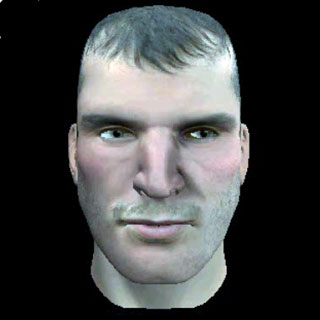
INTRODUCING "E": a computer character
first created in 2005 to embody Bringsjord's
working definition of evil.

TROY, N.Y.—The hallowed halls of academia are not the place you would expect to find someone obsessed with evil (although some students might disagree). But it is indeed evil—or rather trying to get to the roots of evil—that fascinates Selmer Bringsjord, a logician, philosopher and chairman of Rensselaer Polytechnic Institute's Department of Cognitive Science here. He's so intrigued, in fact, that he has developed a sort of checklist for determining whether someone is demonic, and is working with a team of graduate students to create a computerized representation of a purely sinister person.
"I've been working on what is evil and how to formally define it," says Bringsjord, who is also director of the Rensselaer AI & Reasoning Lab (RAIR). "It's creepy, I know it is."
To be truly evil, someone must have sought to do harm by planning to commit some morally wrong action with no prompting from others (whether this person successfully executes his or her plan is beside the point). The evil person must have tried to carry out this plan with the hope of "causing considerable harm to others," Bringsjord says. Finally, "and most importantly," he adds, if this evil person were willing to analyze his or her reasons for wanting to commit this morally wrong action, these reasons would either prove to be incoherent, or they would reveal that the evil person knew he or she was doing something wrong and regarded the harm caused as a good thing.
Bringsjord's research builds on earlier definitions put forth by San Diego State University philosophy professor J. Angelo Corlett as well as the late sociopolitical philosophers and psychologists, Joel Feinberg and Erich Fromm, but most significantly by psychiatrist and author M. Scott Peck in his 1983 book, People of the Lie, The Hope for Healing Human Evil. After reading Peck's tome about clinically evil people, "I thought it would be interesting to come up with formal structures that define evil," Bringsjord says, "and, ultimately, to create a purely evil character the way a creative writer would."
He and his research team began developing their computer representation of evil by posing a series of questions beginning with the basics—name, age, sex, etcetera—and progressing to inquiries about this fictional person's beliefs and motivations.
This exercise resulted in "E," a computer character first created in 2005 to meet the criteria of Bringsjord's working definition of evil. Whereas the original E was simply a program designed to respond to questions in a manner consistent with Bringsjord's definition, the researchers have since given E a physical identity: It's a relatively young, white man with short black hair and dark stubble on his face. Bringsjord calls E's appearance "a meaner version" of the character Mr. Perry in the 1989 movieDead Poets Society. "He is a great example of evil," Bringsjord says, adding, however, that he is not entirely satisfied with this personification and may make changes.
                       
The researchers have placed E in his own virtual world and written a program depicting a scripted interview between one of the researcher's avatars and E. In this example, E is programmed to respond to questions based on a case study in Peck's book that involves a boy whose parents gave him a gun that his older brother had used to commit suicide.
The researchers programmed E with a degree of artificial intelligence to make "him" believe that he (and not the parents) had given the pistol to the distraught boy, and then asked E a series of questions designed to glean his logic for doing so. The result is a surreal simulation during which Bringsjord's diabolical incarnation attempts to produce a logical argument for its actions: The boy wanted a gun, E had a gun, so E gave the boy the gun.
Bringsjord and his team by the end of the year hope to have completed the fourth generation of E, which will be able to use artificial intelligence and a limited set of straightforward English (no slang, for example) to "speak" with computer users.
Following the path of a true logician, Bringsjord's interest in the portrayal of virtuousness and evil in literature led to his interest in software that helps writers develop ideas and create stories; this, in turn, spurred him to develop his own software for simulating human behavior, both good and odious, says Barry Smith, a distinguished professor of bioinformatics and ontology at the State University of New York at Buffalo who is familiar with Bringsjord's work. "He's known as someone on the fringe of philosophy and computer science."
Bringsjord and Smith both have an interest in finding ways to better understand human behavior, and their work has attracted the attention of the intelligence community, which is seeking ways to successfully analyze the information they gather on potential terrorists. "To solve problems in intelligence analysis, you need more accurate representations of people," Smith says. "Selmer is trying to build really good representations of human beings in all of their subtlety."
Bringsjord acknowledges that the endeavor to create pure evil, even in a software program, does raise ethical questions, such as, how researchers could control an artificially intelligent character like E if "he" was placed in a virtual world such asSecond Life, a Web-based program that allows people to create digital representations of themselves and have those avatars interact in a number of different ways.
"I wouldn't release E or anything like it, even in purely virtual environments, without engineered safeguards," Bringsjord says. These safeguards would be a set of ethics written into the software, something akin to author Isaac Asimov's "Three Laws of Robotics" that prevent a robot from harming humans, requires a robot to obey humans, and instructs a robot to protect itself—as long as that does not violate either or both of the first two laws.
"Because I have a lot of faith in this approach," he says, "E will be controlled."
Source:
http://www.scientificamerican.com/article.cfm?id=defining-evil

divendres, 9 de març del 2012

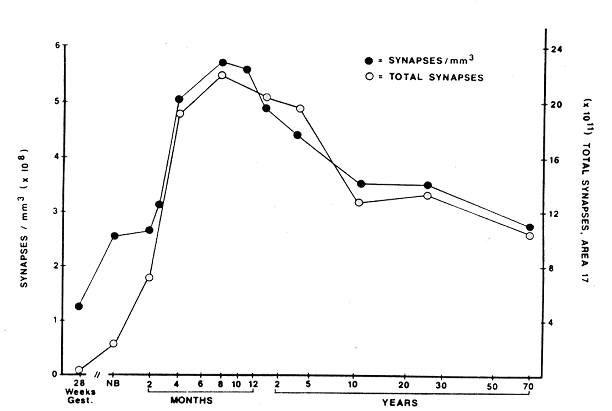
Brain developement: the early years, pre- and post-natal

Baby brains don't actually have more neurons than adults, but way more (and way denser) synapses (the connections between neurons). But as they grow up, neurons and synapses tend to die out while, at the very same time, they remaining neurons tend to specialize and reinforce the kind of connections they've learnt to use.

In the ground breaking report of their Early Years Study, co-chairs Margaret Norrie McCain and J. Fraser Mustard stated that ". . . early child development is as important, if not more important . . . than the periods children spend in education or post-secondary education." Their study found that the development of the brain (at an early age) sets the base for competence and coping skills for the later stages of life.

The first three years, the study concluded, are especially crucial in the growth of a child's brain. A baby is born with billions of neurons in its brain. While brain cells grow throughout life, it is during the early years, the most sensitive period, when these neurons develop their function and key connections. Loving interactions between the child and other human beings provide the stimulation and nourishment that these neurons need "to connect" with one another. Conversely, if neurons are not stimulated early in life, they tend to wither and become more difficult to stimulate.

How well this web of connectedness is established in an individual child depends on two factors:

  • who the parents are, in other words, what genetic code is passed on to the child; and
  • the environment in which the child is raised - how the child is nurtured, protected and loved.

Source: http://www.take30.pe.ca/home.php?page=learn


Source : http://snarkmarket.com/blog/snarkives/science/


Alison Gopnik, Ph.D., an internationally recognized leader in the study of children's learning and development, served as the keynote speaker at this year's It's Good Business to Invest in Young Children Annual Luncheon, giving attendees insight into the sophisticated way that young children learn.


Graph developed by the Council for Early Child Development
(re: Nash, 1997; Early Years Study, 1999, Shonkoff, 2000).

There are a number of critical periods in the first three years of brain development. During these periods, specific brain functions go through fundamental growth and formation. The months after birth, for example, are critical periods for the development of vision and hearing. The years between three and four are a critical period for the development of social skills.

During critical periods, the brain is most sensitive, or able to be shaped, by a child’s environment and experiences, positive and negative. These sensitive periods present unique opportunities to affect healthy development. Providing appropriate experiences during critical periods of development helps children to reach their potential.

As with building a house, the brain is built in a particular order, from the “bottom up.” Brain circuits that process basic information are wired earlier than circuits that process more complex information. If lower-level circuits aren’t wired properly, then higher-level circuits will be faulty. Speech, for example, must be built on circuits for hearing that are developed very early in an infant’s life, long before a child starts talking.

Source: 
https://www.ecmap.ca/Early-Childhood-Development/Pages/How-the-Brain-Develops.aspx

diumenge, 4 de març del 2012

El cerebro depresivo es hiperactivo, forma conexiones pero es incapaz de "apagarlas"

Lo determinó un estudio de la Universidad de California en Los Ángeles que comprobó que los cerebros de gente depresiva tienen mayor número de conexiones

elcivico.com // Jueves 1 de Marzo de 2012

Estados Unidos.- Investigadores de la Universidad de California en Los Ángeles (UCLA) comprobaron que las personas con depresión tienen mayor número de conexiones en todo el cerebro. Lo más llamativo que detectaron es que la principal diferencia de un cerebro depresivo es que está hiperconectado.

Según revelan los autores en la revista PLoS One, el hallazgo explicaría por qué la depresión clínica suele cursar con ansiedad, falta de atención y concentración, problemas de memoria y trastornos del sueño.

De acuerdo con Muy Interesante, Andrew Leuchter, investigador del Instituto de Neurociencia y Comportamiento Humano de UCLA y coautor del estudio que implicó a 121 adultos con depresión severa, “el cerebro sano debe ser capaz de sincronizar, primero, y desincronizar, después, distintas áreas para reaccionar ante lo que nos sucede, regular el ánimo, aprender y resolver problemas”. El problema del cerebro depresivo, agrega Leuchter, es que conserva su habilidad para formar conexiones pero es incapaz de “apagarlas”.

En los pacientes, el área del cerebro que mostraba más conexiones anormales era la corteza prefrontal, implica en regular el estado de ánimo, tomar decisiones y resolver situaciones problemáticas. “Cuando el cerebro pierde su capacidad de controlar sus propias conexiones, es incapaz de adaptarse a los cambios”, resume el investigador.

Fuente:
http://www.elcivico.com/notas/2012/3/1/cerebro-depresivo-hiperactivo-forma-conexiones-incapaz-apagarlas-82410.asp

Reading fiction improves the subjects' social skills

Fiction-reading activates neuronal pathways in the brain that measurably help the reader better understand real human emotion — improving his or her overall social skillfulness

Harvard Business Review // January 11, 2012 // by Anne Kreamer

Over the past decade, academic researchers such as Oatley and Raymond Mar from York University have gathered data indicating that fiction-reading activates neuronal pathways in the brain that measurably help the reader better understand real human emotion — improving his or her overall social skillfulness. For instance, in fMRI studies of people reading fiction, neuroscientists detect activity in the pre-frontal cortex — a part of the brain involved with setting goals — when the participants read about characters setting a new goal. It turns out that when Henry James, more than a century ago, defended the value of fiction by saying that "a novel is a direct impression of life," he was more right than he knew.

In one of Oatley and Mar's studies in 2006, 94 subjects were asked to guess the emotional state of a person from a photograph of their eyes. "The more fiction people [had] read," they discovered, "the better they were at perceiving emotion in the eyes, and...correctly interpreting social cues." In 2009, wondering, as Oatley put it, if "devouring novels might be a result, not a cause, of having a strong theory of mind," they expanded the scope of their research, testing 252 adults on the "Big Five" personality traits — extraversion, emotional stability, openness to experience, agreeableness and conscientiousness — and correlated those results with how much time the subjects generally spent reading fiction. Once again, they discovered "a significant relation between the amount of fiction people read and their empathic and theory-of-mind abilities" allowing them to conclude that it was reading fiction that improved the subjects' social skills, not that those with already high interpersonal skills tended to read more.
Theory of mind, the ability to interpret and respond to those different from us — colleagues, employees, bosses, customers and clients — is plainly critical to success, particularly in a globalized economy. The imperative to try to understand others' points of view — to be empathetic — is essential in any collaborative enterprise.
Emotions also have an impact on the bottom line. A 1996 study published in the journal Training and Development assessing the value of training workers at a manufacturing plant in emotional management skills — teaching employees to focus on how their work affects others rather than simply on getting the job done — found that union grievance filings were reduced by two-thirds while productivity increased substantially. And a study of a Fortune 400 health insurance company conducted by Peter Salovey, a psychology professor at Yale, looked at the correlations between emotional intelligence and salary and found that people rated highest by their peers in emotional intelligence received the biggest raises and were promoted most frequently. (...)

Source:
http://blogs.hbr.org/cs/2012/01/the_business_case_for_reading.html

divendres, 17 de febrer del 2012

Understanding Empathy

One of the greatest problems of moral psychology, and perhaps one of t he greatest problems in human history has been explored by many people in many disciplines: Why do normal people commit atrocities? Jean Decety, a leader in empathy research, addresses this question in the context of his work.


Source:
Understanding empathy. University of Chicago Center for Cognitive and Social Neuroscience Summer 2010 Newsletter
http://home.uchicago.edu/~decety/research.html

dimecres, 15 de febrer del 2012

"Los rasgos de nuestro cuerpo afectan a nuestros pensamientos de una forma predecible, y en muchas áreas distintas de la vida, desde el lenguaje hasta las emociones"

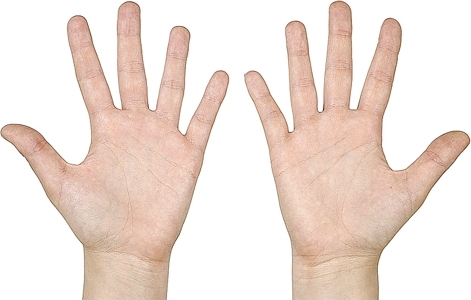
El hecho de ser personas zurdas o diestras puede influir en nuestros juicios sobre ideas abstractas como el valor, la inteligencia o la honestidad. En una serie de experimentos, los científicos descubrieron que, en general, la gente tiende a preferir cosas que se encuentra en el mismo lado de su mano dominante.
Con las evaluaciones abstractas sucedería lo mismo: solemos asociar lo “bueno” con la derecha y lo “malo” con la izquierda, porque el 90% de la población es diestra. 


Nos gusta pensar en nosotros mismos como criaturas racionales, capaces de tomar decisiones bien meditadas. Pero en realidad no somos así.

En las últimas décadas, los científicos han demostrado que hay muchos factores internos y externos que influyen en nuestra manera de pensar, sentir, comunicarnos y tomar decisiones en un momento dado.

Uno de estos más influyentes factores es nuestro propio cuerpo, revela una investigación realizada por el científico Daniel Casasanto, de The New School for Social Research de Estados Unidos.

Casasanto ha demostrado que los rasgos de nuestro cuerpo afectan a nuestros pensamientos de una forma predecible, y en muchas áreas distintas de la vida, desde el lenguaje hasta las emociones.

Por ejemplo, según el investigador, el hecho de ser personas zurdas o diestras puede influir en nuestros juicios sobre ideas abstractas como el valor, la inteligencia o la honestidad. En una serie de experimentos, los científicos descubrieron que, en general, la gente tiende a preferir cosas que se encuentra en el mismo lado de su mano dominante.

Con las evaluaciones abstractas sucedería lo mismo: solemos asociar lo “bueno” con la derecha y lo “malo” con la izquierda, porque el 90% de la población es diestra. De hecho, afirma Casasanto, personas diestras que han sufrido una lesión permanente en su mano derecha, pasado el tiempo, comienzan a asociar el “bien” con la izquierda, la mano que más usan.

Fuente:
http://www.tendencias21.net/notes/Cuerpos-diferentes-mentes-distintas_b3844195.html

"The areas of the brain activated by intense love are the same areas that drugs use to reduce pain"


"There is intense activation in the reward area of the brain—the same area that lights up when you take cocaine, the same area that lights up when you win a lot of money."

There's nothing quite like the feeling you have in those first nine months of being in love. It's positively blissful, almost as if you've taken some sort of mind-altering substance that ups your sense of joy and dulls your sense of pain. As it turns out, that's not terribly far from the truth; new research reveals how the feelings of intense romantic love can actually reduce the sensation of physical pain, harnessing the same neural pathways used by more traditional painkillers.

Researchers selected volunteers for the study who were in the first nine months of a relationship, reasoning that in this early period, the sense of euphoric limerence is highest. They then scanned the brains of the subjects using fMRI while the volunteers were either looking at a photo of their beloved, looking at a photo of an acquaintance who was similar to their partner, or performing a word association task. While doing each of these things, the volunteers received a small jolt of pain on the hand, and were asked to report just how much it had hurt.

The researchers found that, although the word association task also numbed the pain by distracting the cognitive parts of the brain, looking at one's beloved reduced pain by a distinctive pathway: activating the reward centers of the brain much as opiates do. Love, like heroin, blasts you with dopamine. And, of course, withdrawal from that dopamine surge helps to explain why falling out of love hurts so much—it's going cold turkey.

"The areas of the brain activated by intense love are the same areas that drugs use to reduce pain," Arthur Aron, a professor of psychology at the State University of New York at Stony Brook and coauthor of the new study, said in a prepared statement. "There is intense activation in the reward area of the brain—the same area that lights up when you take cocaine, the same area that lights up when you win a lot of money."

Dopamine, oxytocin, vasopressin, and all the other brain chemicals that contribute to the feelings we have while in love serve a critical evolutionary purpose, cementing families together. The exhilaration of romantic bonding helped, and still helps, our species to thrive. If love is a drug, it's a drug that helped make humanity what it is today. Not such a bad addiction, after all.


Source:
http://www.beinghuman2012.org/news/2012/02/14/love-is-the-drug-im-thinking-of/

dijous, 9 de febrer del 2012

Quan l'empatia és baixa, el nostre cervell prefereix les jerarquies socials

Un grup de científics suggereixen una base neurobiològica per a les actituds socials i polítiques
Què prefereix el teu cervell, jerarquia o igualtat?


Ara.cat / DAVID BUENO | Actualitzada el 09/02/2012 00:00

Una de les idees més antigues i controvertides de la història humana és que hi ha persones o grups que són intrínsecament superiors als altres, la qual cosa s'ha utilitzat sovint per atiar conflictes humans, com les colonitzacions i les guerres santes. Encara n'hi ha que estan convençuts de l'existència d'una jerarquia de dominància entre grups humans, amb un important rerefons cultural i lingüístic.

Moltes altres espècies animals tenen també una certa estructura social rere la qual hi ha una organització jeràrquica de dominància que s'origina a partir dels seus instints biològics. Generalment, els grups i els individus socialment dominants tenen un accés privilegiat a les fonts de recursos, com el territori i el menjar, i també a les parelles reproductores. Tanmateix, la manera com s'organitzen les societats humanes és molt més diversa i complexa, i inclou des de societats amb una forta organització jeràrquica interna i respecte als altres grups fins a societats molt més igualitàries. En l'espècie humana, ¿aquesta dicotomia entre societat jerarquitzada o igualitària és únicament una convenció social, com s'ha pensat tradicionalment, o té alguna base neural?

La investigadora Joan Y. Chiao i els seus col·laboradors, del departament de psicologia de la Northwest University d'Illinois, han publicat un estudi que suggereix, segons els autors, "una base neurobiològica per a les actituds socials i polítiques relatives a la dominància social, la qual cosa té importants implicacions en l'estudi de l'equitat de la justícia i de les relacions intergrupals".

Estudis previs de psicologia social indiquen que cada persona té un nivell diferent de preferència pel que fa al fet que el seu grup en domini d'altres, un fenomen que s'anomena orientació de dominància social i que es pot quantificar amb tests psicològics. També indiquen que, entre les cultures humanes, l'orientació de dominància social és una característica estable que permet predir una àmplia gamma d'actituds socials i polítiques. Per exemple, les persones que prefereixen una jerarquia social s'oposen a les polítiques que intenten atenuar les desigualtats socials, com ara els drets civils i de les minories i els drets de les dones i els homosexuals. En canvi, les persones que mostren més empatia i més capacitat per sentir i compartir les emocions i el dolor dels altres acostumen a preferir relacions socials igualitàries.

Empatia, jerarquia i igualtat

Segons aquests coneixements, Chiao i els seus col·laboradors van examinar la relació entre el funcionament dels centres cerebrals relacionats amb l'empatia i les preferències d'organització social. L'empatia és una capacitat mental que es genera en diferents regions del cervell, entre les quals hi ha l'ínsula i el còrtex cingulat anteriors. A un grup de voluntaris els van mostrar escenes de persones en situacions doloroses o alternativament neutres mentre examinaven la seva activitat neural mitjançant ressonància magnètica funcional. En acabar els van preguntar què havien sentit i van determinar la seva orientació de dominància social amb un test psicològic.

En tots els voluntaris la ressonància va mostrar una activació específica de les neurones mirall, un conjunt de neurones que permeten reproduir mentalment les accions, les intencions i els sentiments dels altres. Els individus que preferien una jerarquia de dominància social van mostrar una activitat neural menor quan percebien el dolor dels altres. És a dir, que la preferència per una organització jeràrquica o més igualitària va associada al funcionament de regions cerebrals vinculades amb l'habilitat de compartir i de sentir preocupació pel dolor dels altres, i per tant té una base biològica al cervell. Tanmateix, aquest treball no clarifica si aquesta activació cerebral diferencial es produeix únicament per aprenentatge i/o en funció dels condicionaments externs del moment o si també té alguna base genètica.

Font: 
http://www.ara.cat/ara_premium/ara_tu/Que-prefereix-cervell-jerarquia-igualtat_0_643135701.html

dilluns, 6 de febrer del 2012

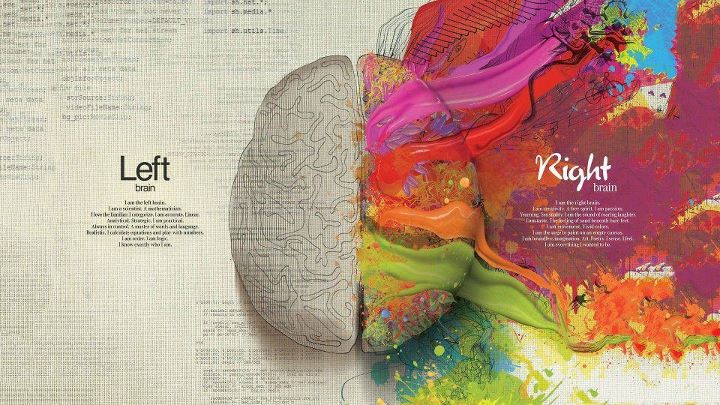
Test: ¿Qué hemisferio predomina en tu cerebro?

Cómo saber qué hemisferio predomina
Fernando Alberca apunta que un método fácil para que cada persona sepa qué hemisferio lleva la batuta en su cerebro es el conocido como test de la bailarina.

Mira atentamente la siguiente imagen y di hacia qué lado gira:


Se trata de la imagen de un maniquí en movimiento que unos ven girar hacia la derecha (quienes tienen predominio del hemisferio derecho), otros hacia la izquierda, y algunos cambiar de sentido en función del hemisferio cerebral que activan antes. Pero hay otras formas de detectarlo. “Si a un niño se le pide que dibuje un árbol, los de hemisferio derecho dibujarán además el suelo, el sol y otros detalles fruto de su imaginación, y los regidos por el izquierdo dibujarán sólo el árbol”, explica. También es fácil descubrirlo cuando alguien resume una película: los de hemisferio izquierdo lo hacen secuencia a secuencia, y los del derecho, se centran en lo relevante sin tener en cuenta el orden cronológico.

Fuente:
http://www.lavanguardia.com/estilos-de-vida/20120203/54247867713/la-escuela-mata-la-creatividad.html

dimarts, 17 de gener del 2012

Good Food, God Cognition


The Connection Between Good Nutrition and Good Cognition // A study that looked at biomarkers in the blood to correlate vitamins and brain function found very clear links between nutrition and brain health.

The Atlantic // 13th January 2012

A new study goes deeper in understanding the connection between good nutrition and a healthy brain. Previous studies have linked individual vitamin deficiencies to cognitive decline. But new research looks at a wider range of vitamins, and even better, it uses biomarkers in the blood to correlate vitamins with brain health, both good and bad.

Many studies exploring the relationship between nutrition and cognitive health rely on people's personal reports of their diets -- a notoriously unreliable way to gather personal nutritional information. For this reason, the researchers behind the current study decided to use a more objective means of studying the nutrition-brain link: they looked at biomarkers in the blood to measure the vitamin levels in 104 participants. They also had participants take tests to measure thinking and memory function, and 42 participants had MRI scans to measure their brain volume.

The researchers found some striking connections between nutrition and brain health. People who had higher levels of B family vitamins, as well as vitamins C, D, and E had higher scores on cognitive tests than people with lower levels. The same positive relationship was found for omega-3 fatty acids, which have previously been linked to better brain health.

On the flipside, people with higher levels of trans fats in their blood had poorer performance in thinking and memory tests. Their MRI scans also revealed more brain shrinkage than people who had lower trans fats levels. Trans fats are found in a variety of junk foods, like fried, packaged, and fast foods.

The researchers also determined the portion of the cognitive test scores the participants' nutrient statuses accounted for. They found that nutrient biomarkers accounted for 17 percent of the variation in the tests of thinking and memory function. Other variables, like age, education, and having high blood pressure accounted for more: 46 percent. But for brain volume, the role of nutrition was larger, accounting for 37 percent of the variation.

Author Gene Bowman said that the team's findings "need to be confirmed, but obviously it is very exciting to think that people could potentially stop their brains from shrinking and keep them sharp by adjusting their diet."

More and more research is showing that there's a lot of truth to the old adage you are what you eat -- and the same goes for the brain since, after all, it is an organ too. Genetic and environmental factors also play a role in the development of disease, but we can do our best to give our brains the nutrients they need for good cognitive health.

The study was carried out at the Oregon Health & Science University in Portland, and is published in Neurology.

Source: http://www.theatlantic.com/health/archive/2012/01/the-connection-between-good-nutrition-and-good-cognition/251227/


Original Source: http://www.neurology.org/content/early/2011/12/28/WNL.0b013e3182436598.abstract?sid=22557f7c-d732-4ce6-a48f-a4bd08316626
Nutrient biomarker patterns, cognitive function, and MRI measures of brain aging
G.L. Bowman, ND, MPH, L.C. Silbert, MD, MCR, D. Howieson, PhD, H.H. Dodge, PhD, M.G. Traber, PhD, B. Frei, PhD, J.A. Kaye, MD, J. Shannon, PhD, MPH and J.F. Quinn, MD