dissabte, 30 d’abril del 2011

Are Women More Emotionally Intelligent Than Men?


Psycology Today // Published on April 29, 2011 by Dan Goleman in The Brain and Emotional Intelligence

Yes, and Yes and No. Emotional intelligence has four parts: self-awareness, managing our emotions, empathy, and social skill. There are many tests of emotional intelligence, and most seem to show that women tend to have an edge over men when it comes to these basic skills for a happy and successful life. That edge may matter more than ever in the workplace, as more companies are starting to recognize the advantages of high EI when it comes to positions like sales, teams, and leadership.

On the other hand, it's not that simple. For instance, some measures suggest women are on average better than men at some forms of empathy, and men do better than women when it comes to managing distressing emotions. Whenever you talk about such gender differences in behavior, your are referring to two different Bell Curves, one for men and one for women, that largely overlap. What this means is that any given man might be as good or better as any woman at empathy, and a woman as good as or better than a specific man at handling upsets.

Let's look at empathy. There are three kinds: cognitive empathy, being able to know how the other person sees things; emotional empathy, feeling what the other person feels; and empathic concern, or sympathy -being ready to help someone in need.

Women tend to be better at emotional empathy than men, in general. This kind of empathy fosters rapport and chemistry. People who excel in emotional empathy make good counselors, teachers, and group leaders because of this ability to sense in the moment how others are reacting.

Neuroscientists tell us one key to empathy is a brain region called the insula, which senses signals from our whole body. When we're empathizing with someone, our brain mimics what that person feels, and the insula reads that pattern and tells us what that feeling is.

Here's where women differ form men. If the other person is upset, or the emotions are disturbing, women's brains tend to stay with those feelings. But men's brains do something else: they sense the feelings for a moment, then tune out of the emotions and switch to other brain areas that try to solve the problem that's creating the disturbance.

Thus women's complaint that men are tuned out emotionally, and men's that women are too emotional - it's a brain difference.

Neither is better - both have advantages. The male tune-out works well when there's a need to insulate yourself against distress so you can stay calm while others around you are falling apart - and focus on finding a solution to an urgent problem. And the female tendency to stay tuned in helps enormously to nurture and support others in emotional trying circumstances. It's part of the "tend-and-befriend" response to stress.

There's another way of looking at male-female differences in EI: Simon Bar-On Cohen at Cambridge University, says that there's an extreme "female brain" which is high in emotional empathy -- but not so good at systems analysis. By contrast, the extreme "male brain" excels in systems thinking and is poor at emotional empathy (he does not mean that all men have the "male brain", nor all women the "female brain" of course; many women are skilled at systems thinking, and many men at emotional empathy).

Psychologist Ruth Malloy at the HayGroup Boston studies excellence in leaders. She finds when you only look at the stars -- leaders in the top ten percent of business performance -- gender differences in emotional intelligence abilities wash out: The men are as good as the women, the women as good as the men, across the board.

That echoes a discovery by scientists who study primates. When a chimp sees another chimp who is upset, say from an injury, she mimics the distress, a way of showing empathy. Some chimps will then go over and give some solace to the upset chimp, for example, stroking the other to help it calm down. Female chimps do this more often than male chimps do - with one intriguing exception: The alpha males, the troupe leaders, give solace even more often than do female chimps. In nature's design, leaders, it seems, need a large dose of empathic concern.

Source:
http://www.psychologytoday.com/blog/the-brain-and-emotional-intelligence/201104/are-women-more-emotionally-intelligent-men

dissabte, 23 d’abril del 2011

Sant Jordi amb Howard Gardner

Howard Gardner i la seva teoria de les intel·ligències múltiples, m'ha semblat el llibre més atraient per celebrar aquest Sant Jordi.


Inteligencias múltiples. La Teoría en la Práctica
GARDNER, Howard

ISBN: 978-84-493-1806-1
EAN: 9788449318061
Editorial: EDICIONES PAIDÓS IBÉRICA, S.A.
Precio: 14.00 €


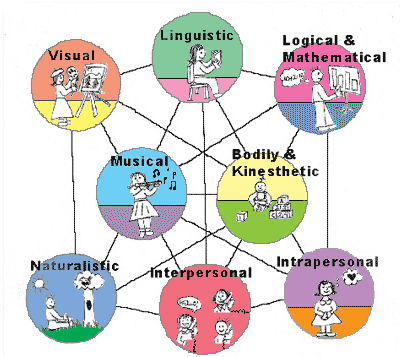
Este libro es una propuesta moderna y arriesgada que pretende explicar la manera en que la gente desarrolla las capacidades más importantes para su modo de vida: la inteligencia lingüística, la lógico-matemática, la espacial, la musical, la corporal y cinética, la interpersonal y la intrapersonal. Todas ellas se utilizan para resolver los distintos problemas que se nos puedan plantear cotidianamente y para alcanzar diversos fines culturales: vocaciones, aficiones y similares.
La conclusión no es sólo que la escuela del futuro debería centrarse en el individuo y ayudarle a desarrollar todas esas inteligencias, sino también que cada persona tiene su propia manera de combinarlas y utilizarlas, aunque quizá no la conozca aún. En cualquier caso, la misión de este apasionante libro es lograr que la descubra.

______________________

El psicólogo evolutivo Howard Gardner en 1983, publicó la obra"Los Marcos de la Mente: LA TEORÍA DE LAS INTELIGENCIAS MÚLTIPLES", en la que revela la pluralidad del intelecto al definir y describir ocho inteligencias diferenciadas, las cuales trabajan juntas para resolver problemas y alcanzar divesos fines. Para Gardner las ocho inteligencias tienen el mismo grado de importancia y es preciso que las escuelas reconozcan y se organicen para alimentar toda la variedad de inteligencias y todas las combinaciones de las inteligencias de los y las estudiantes.


Gardner describe ocho tipos de inteligencias diferenciadas en el ser humano siendo ellas:

Inteligencia lingüístico- verbal: Los y las estudiantes demuestran esta inteligencia cuando utilizan el lenguaje para describir, informar, connvencer y son sensibles a las palabras. Se estimula proporcionándoles materiales para elaborar peíódicos murales Permite, narrar, escribir, describir, informar, convencer, resumir, etc.
Inteligencia lógico-matemática: Se demuestra esta inteligencia cuando los y las estudiantes practican destrezas de razonamiento y solucion de problemas. Permite enumerar, deducir, medir. Es característica de los científicos. Se estimula a través de juegos matemáticos y lógicos.
Inteligencia musical: esta inteligencia los y las estudiantes la demuestran cuando cantan, tararean, reconocen diferentes sonidos y perciben los diferentes matices. Se estimula practicando con instrumentos musicales y jugando con diferentes sonidos.
Inteligencia Interpersonal: Esta inteligencia se manifesta cuando los y las estudianes comprenden a los demás, se comunican, resuelven conflictos se organizan y hacen amigos. Permite interactuar con los demás, poder comprender a otras personas. Se estimula a través de juegos de socialización.
Inteligencia visual-espacial: Inteligencia que se demuestra cuando los y las estudiantes manifiestan habilidad para orientarse, pensar en tres dimensiones permite distinguir formas y objetos con precisión, y transformar los objetos a través de la imaginación, localizar objetos con precisión en el espacio y el tiempo. Se estimula mediante el dibujo, diseño y utilización de mapas, lecturas compartidas, jugos y contemplar obras de arte.
Inteligencia cinético-corporal: Los y las estudiantes demuestran esta inteligencia cuando actúan, hacen manualidades ,permite usar el cuerpo con habilidad y con fines expresivos. Característica de los grandes bailarines y deportistas, actores, Se estimula con juegos que permitan aumentar las capacidades de los sentidos, con actividades teatrales, bailes y deportes.
Inteligencia naturalista o ambiental: Esta inteligencia se manifiesta cuando los y las estudiantes sienten atracción y sensibilidad por el mundo natural, fenómenos científicos, explorar seres vivos, etc. Se estimula investigando la naturaleza, actuando sobre ella y analizando los fenómenos naturales.
Inteligencia intrapersonal: Esta inteligencia tiene la característica de ser mas privada está orientada hacia dentro, y requiere de otras inteligencias para poder ser observada en funcionamiento. Debe proporcionársele oportunidades para hacer sus proyectos personales proporcionandole espacios tranquilos y privados, materiales para escribir y expresarse.
Fuente:
http://fineans.usac.edu.gt/wiki/index.php/MARFFDEP_Estrategias_de_aprendizaje

divendres, 15 d’abril del 2011

Crean el primer atlas integral del cerebro humano (tendencias21.net)

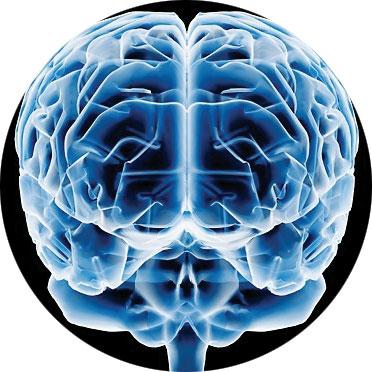
Combina la información de 1.000 localizaciones anatómicas con 100 millones de datos genéticos. El Allen Institute for Brain Science, de Estados Unidos, ha lanzado el “Allen Human Brain Atlas”, que es el primer mapa del cerebro humano que integra tanto la anatomía como la genómica del cerebro. De acceso gratuito y abierto en Internet, este recurso funciona como un GPS: es capaz de identificar 1.000 localizaciones anatómicas del cerebro humano, y complementa esta información con más de 100 millones de datos sobre la expresión genética particular de cada localización, así como sobre su bioquímica subyacente. La posibilidad de observar cómo funcionan los genes a nivel cerebral ayudará a conocer este misterioso órgano, y a descubrir nuevos tratamientos para todo el espectro de trastornos y enfermedades cerebrales. 


Por Yaiza Martínez // Tendencias21.net // 15 de abril de 2011

El Allen Institute for Brain Science, de Estados Unidos, ha hecho público el llamado “Allen Human Brain Atlas”, el primer mapa del cerebro humano que integra tanto la anatomía como la genómica (o información genética) del cerebro.

El empleo de las tecnologías más punteras de análisis cerebral y más de cuatro años de rigurosos estudios y trabajos de documentación han hecho posible el desarrollo de este atlas de nuestra materia gris, publica el Instituto Allen en un comunicado.

El Allen Human Brain Atlas es ya un recurso abierto para científicos, médicos y comunidad educativa en la Red. Con él se pretende acelerar la comprensión del funcionamiento del cerebro, y también potenciar nuevos descubrimientos al respecto por parte de la comunidad científica global. (...)

Fuente y artículo entero: 
http://www.tendencias21.net/Crean-el-primer-atlas-integral-del-cerebro-humano_a6290.html

dimarts, 12 d’abril del 2011

Una persona (sin conocimientos de Morfopsicología) puede distinguir por la cara un criminal // Criminals Look Different From Noncriminals // Test

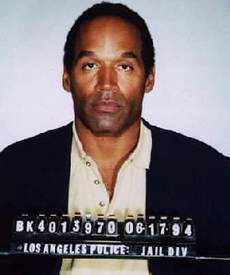
Contrary to popular belief, you can assess people's character and personality by simply looking at them.  Nice people look nice, and nasty people look nasty, and it appears that humans have innate psychological mechanisms to tell them apart.  Now, in a truly groundbreaking study, recently published in the Journal of Social, Evolutionary, and Cultural Psychology, Jeffrey M. Valla, Stephen J. Ceci, and Wendy M. Williams of Cornell University show that people can tell criminals and noncriminals apart simply by looking at their still photos.  Criminals, it appears, look different from noncriminals.


psychologytoday.com  // by Satoshi Kanazawa

(...) In their experiments, Valla et al. show pictures of the faces of 32 young Caucasian men in their 20s, without scars, tattoos or excessive facial hair, all in neutral expressions.  Sixteen of them are convicted criminals, and the other sixteen are not.  Valla et al. simply ask their experimental participants to indicate how likely they think it is that each man is a certain type of criminal (murderer, rapist, thief, forgerer, assailant, arsonist, and drug dealer) on a 7-point Likert scale from 1 = extremely unlikely to 7 = extremely likely.  Their results from two experiments consistently show that individuals can tell who is a criminal and who is not, by indicating that they believe the actual criminals have higher probability of being a criminal than actual noncriminals.  However, their results also show that individuals cannot tell what type of criminals they are.

(...) For your amusement, I include the visual material that Valla et al. use in one of their experiments.  It contains pictures of 32 men, 16 of whom are convicted criminals (arsonists, assailants, drug dealers, and rapists), and 16 of whom are noncriminals (normal college students).  Can you spot the difference?  Can you tell which of them are criminals and which of them are not?  If you are a woman, can you spot the convicted rapists among them?


If you want to know the answers, you will have to access Valla et al.'s article here.  The answers are in the Appendix at the end of their paper.

Source: http://www.psychologytoday.com/blog/the-scientific-fundamentalist/201103/criminals-look-different-noncriminals

Non-Criminal – 1, 2, 6, 7, 9, 12, 13, 14, 15, 17, 18, 19, 22, 25, 26,30; Arson – 5, 10, 16, 20; Assault – 4, 24, 27, 28; Drug Dealing – 8, 11, 21, 29; Rape – 3,23, 31, 32

dimarts, 5 d’abril del 2011

El método de Pierre Abraham de análisis de las hemicranas

1929 Pedro Abraham: La hemicrana. La cara no es simétrica. Mediante el estudio de la hemicrana izquierda separada de la derecha puedo ser informado del estado del yo privado y del yo social.

Pierre Abraham fue el primero que trató de interpretar el significado de las asimetrías psicológicas. La Morfopsicología ha vinculado la hemicrana derecha con el hemisferio izquierdo del cerebro y a la inversa. Para hacer una análisis a menudo resulta muy útil hacer este tipo de fotomontajes que ponen en evidencia como ha sido el pasado y como es el presente de una persona.


dilluns, 4 d’abril del 2011

Redes 89: Los secretos de la creatividad

Todos poseemos un talento, todos tenemos la capacidad de ser creativos; y la mayoría vivimos sin saberlo, convencidos muchas veces de que el creativo es aquel que sabe componer melodías, o escribir una poesía.

REDES // “Los secretos de la creatividad” // Emisión 89 (27/03/2011) // Temporada 15


Ken Robinson reclama en este capítulo de Redes la necesidad de que en nuestra sociedad existan entornos donde cada uno pueda encontrar la inspiración necesaria para desarrollar su creatividad.

"La creatividad es un proceso muy práctico. Hay muchas nociones falsas sobre la creatividad. Una de ellas es que todo se basa en dejarse ir, que ser creativo es hacer cualquier cosa que se te pase por la cabeza. Yo defino la creatividad como el proceso de tener ideas originales que aporten valor. Para ser creativo hay que hacer algo, y esto significa que hay que trabajar con algo. Se puede ser creativo con cualquier cosa: puedes ser un matemático muy creativo y también puedes ser un químico creativo, un entrevistador creativo, un profesor creativo, un académico creativo, un músico creativo... ¡puedes ser creativo con cualquier cosa que implique inteligencia! Pero, para ser creativo, hay que poder, con el tiempo, controlar los materiales con los que trabajas, para obtener los efectos que te interesan y seguir el camino que te fijes."
Transcripción de la entrevista:
http://www.redesparalaciencia.com/wp-content/uploads/2011/03/entrev89.pdf

Más sobre Ken Robinson:
http://sirkenrobinson.com/skr/

dilluns, 28 de març del 2011

PAUL EKMAN On Emotions and Facial Expressions (video playlist)


Dr. Paul Ekman (1934 -)  Paul Ekman was an undergraduate at the University of Chicago and New York University. He received his Ph.D. in clinical psychology at Adelphi University (1958), after a one year internship at the Langley Porter Neuropsychiatric Institute. After two years as a Clinical Psychology Officer in the U.S. Army, he returned to Langley Porter where he worked from 1960 to 2004. His research on facial expression and body movement began in 1954, as the subject of his Master’s thesis in 1955 and his first publication in 1957. In his early work, his approach to nonverbal behavior showed his training in personality. Over the next decade, a social psychological and cross-cultural emphasis characterized his work, with a growing interest in an evolutionary and semiotic frame of reference. In addition to his basic research on emotion and its expression, he has, for the last thirty years, also been studying deceit. Currently, he is the Manager of the Paul Ekman Group, LLC (PEG), a small company that produces training devices relevant to emotional skills, and is initiating new research relevant to national security and law enforcement. In 1971, he received a Research Scientist Award from the National Institute of Mental Health; that Award has been renewed in 1976, 1981, 1987, 1991, and 1997. His research was supported by fellowships, grants and awards from the National Institute of Mental Health for over forty years. Articles reporting on Dr. Ekman’s work have appeared in Time Magazine, Smithsonian Magazine, Psychology Today, The New Yorker and others, both American and foreign. Numerous articles about his work have also appeared in the New York Times, Washington Post and other national newspapers. He has appeared on 48 Hours, Dateline, Good Morning America, 20/20, Larry King, Oprah, Johnny Carson and many other TV programs. He has also been featured on various public television programs such as News Hour with Jim Lehrer, and Bill Moyers’ The Truth About Lying.

Source: http://www.paulekman.com/about-ekman/

dilluns, 21 de març del 2011

Brain-healthy lifestyle // Consejos para tener un estilo de vida sano para nuestro cerebro

This 29-minute video uses footage of neuroscience experts from live Staying Sharp forums to address topics such as changes in the aging brain, memory, and the science behind the healthy brain practices that may help us stay sharp. Throughout this program we draw on insights from top neuroscientists committed to helping more people know about what happens to our brain as we age and the brain-healthy behaviors that we can incorporate into our daily lives.


(El vídeo es visible , aunque la imagen rpevia diga que no lo es. Clica en PLAY)

Here’s a checklist of things to do for a brain-healthy lifestyle:


  • Exercise your body regularly and get involved in physically active leisure pursuits
  • Keep your mind exercised! Engage in active learning throughout life and pursue new experiences
  • Stay socially engaged with friends, family and community groups
  • Maintain a positive attitude and a sense of control over your life
  • Take steps to manage stress
  • Eat a brain-healthy, balanced diet rich in antioxidants and omega-3 fatty acids
  • Consider taking a multivitamin supplement that includes antioxidants and folate
  • Watch your weight: lose any extra pounds
  • Watch your cholesterol: lower it if it’s high
  • Keep your blood glucose and blood pressure under control
  • Get adequate sleep
  • Get proper medical attention and treatment for any underlying health problem

You can read more about the steps you can take to improve your brain fitness today in the Dana Foundation’s booklet Staying Sharp: Successful Aging and Your Brain.

Read more: http://www.highlighthealth.com/highlight-health/brain-awareness-week-staying-sharp/#ixzz1HDq9GGaP

Source: 
http://www.highlighthealth.com/highlight-health/brain-awareness-week-staying-sharp/#axzz1H94CPNLF

divendres, 18 de març del 2011

"Los niños prestan más atención a los objetos y las niñas a las personas", entrevista a Gergely Csibra Investigador del desarrollo cognitivo en los bebés

El País // MAYKA SÁNCHEZ - Madrid - 25/03/2008

Desde 1890, en que el psicólogo William James definió el mundo de los bebés como "una confusión total de zumbidos", se sostenía que los pequeños poseían una mente muy simple que apenas mimetizaba lo poco que captaba a su alrededor. En los años sesenta del pasado siglo se empezó a observar que la mente de los bebés es mucho más compleja y rica de lo que se pensaba. Estudios observacionales realizados con técnicas de electroencefalografía y de diagnóstico por imagen no invasivas e incruentas revelan que, antes de que puedan andar y expresarse verbalmente, su mente es capaz de sentir emociones complejas, como los celos, la empatía o la frustración.

En esta línea de investigación está trabajando Gergely Csibra, catedrático de Psicología Cognitiva del Birkberck College de la Universidad de Londres (Reino Unido). Sus estudios en la capital británica parten de 1994, si bien los había empezado antes en la Universidad de Budapest (Hungría), su ciudad natal. Csibra viajó la semana pasada a España, invitado por CosmoCaixa, el Museo de la Ciencia de la Fundación La Caixa en Alcobendas (Madrid), para hablar sobre la mente de los niños.

"Mis investigaciones", explica, "se centran en varios aspectos del desarrollo cognitivo en los dos primeros años de vida. Estudio los procesos visuales de los niños, desde los niveles más bajos o elementales de atención, y los movimientos de los ojos para conocer qué interés muestran por los objetos y las personas. Es fascinante ver qué fuentes cognitivas emplean los pequeños para aprender de su entorno y cómo discurren los procesos neuronales del cerebro del bebé".

Aunque no admite la existencia de un cerebro de hombre y otro de mujer, como postulan algunos autores, sí que ha observado en sus trabajos diferencias claras según los sexos. Lo que más le ha llamado la atención, dice, es que "mientras que los niños prestan más atención a los objetos, las niñas se muestran más interesadas por las personas".

¿Qué significado puede tener esta observación? "Es difícil saberlo todavía, aunque creemos que con el tiempo llegaremos a conocerlo. Pues lo más probable es que no sea algo casual y que, efectivamente, tenga un significado", responde. En los seis primeros meses de vida el bebé es capaz de distinguir las emociones de quienes le rodean por los gestos faciales, y muy especialmente las de la madre. En este periodo, explica, el lenguaje gestual de la cara es determinante para ellos. Estos hallazgos coinciden plenamente con los de otros investigadores, como Diane Montague, de la Universidad de Filadelfia (Estados Unidos).

En uno de los estudios realizados por Montague se exhibía ante la mirada atenta de bebés de seis meses una cara triste que había estado oculta tras una cortina; se cerraba después la cortina y se volvía a abrir para mostrar una cara alegre. Y así alternativamente, varias veces. "En un principio los bebés sólo observaban con atención, pero luego empezaron a mimetizar los gestos, alegres o tristes, de la cara expuesta. Esto significa que la interacción visual es un elemento clave para su desarrollo cognitivo. El seguimiento de la mirada es un importante factor para adentrarnos en la mente de los bebés, puesto que ni la acción motora ni la verbal están desarrolladas. Toda la información que les va llegando a través de los ojos en torno al primer año de vida les ayuda a interpretar lo que les rodea y a interesarse, más o menos, en función de sus habilidades y preferencias", sostiene Csibra, cuyos estudios han sido publicados en revistas científicas como Journal of Cognitive Neuroscience, British Journal of Developmental Psychology o Progress in Brain Research.

Csibra ha realizado recientemente un estudio con monos para conocer la importancia del juego y la interacción visuales en el desarrollo cognitivo-emocional de los bebés, en la línea de las investigaciones realizadas con chimpancés por Charles Nelson, de la Universidad de Harvard en Boston (Estados Unidos).

Durante el estudio se mostraron a bebés menores de seis meses una serie de fotografías de monos aparentemente iguales, forma que parecían indistinguibles para la mente del adulto. "Sin embargo", explica, "los pequeños reconocían a cada uno de ellos según pudimos comprobar por el interés visual que mostraban. Cuando un mismo animal estaba ya muy visto, se aburrían y cambiaban la mirada, en tanto que si era uno distinto, recuperaban la atención".

"Esta habilidad empiezan a adquirirla respecto de las caras humanas a partir de los nueve meses. Les mostramos caras con expresión de alegría o de pena para que ellos aprendan a establecer categorías. Así, los bebés sonríen o hacen muecas de pena en función de la cara que ven. Es un modo de categorizar por parte de los pequeños los estados de felicidad o de tristeza".

La necesidad de interactuar visualmente se acusa de un modo evidente en los niños institucionalizados. Según los psicólogos, se supone que en los orfanatos o en los centros de acogida están bien atendidos en cuanto a su alimentación, higiene y otros cuidados básicos. "Pero les falta la estimulación que suponen los besos, las miradas o los gestos", advierte Csibra.

La importancia de la interacción visual, según este experto, también se ha estudiado en bebés con madres que sufrían depresión posparto de larga duración y que no interaccionaban visualmente con el niño de igual manera que otra madre sin depresión. Los seres humanos somos esencialmente culturales o sociales, según Csibra, y poseemos unas potencialidades que sólo se desarrollarán si se da el entorno adecuado: "Por muchas potencialidades innatas que posea un bebé, éstas nunca aflorarán en su desarrollo emocional si no se producen los estímulos necesarios".

El compositor Mozart sería un caso paradigmático. Era un genio dotado de un talento especial para la música, pero había nacido además en un entorno musical muy favorable para desarrollar todas sus potencialidades innatas. "Quizá su talento musical no hubiera brillado con el mismo esplendor si su entorno ambiental no le hubiese sido tan propicio. Aunque en el caso de Mozart es tan claro su talento o genio musical, que, de haber nacido en otro entorno, tal vez no habría compuesto el Réquiem, pero es seguro de que de algún modo habrían aflorado sus habilidades innatas", concluye Csibra.

Fuente: http://www.elpais.com/articulo/salud/ninos/prestan/atencion/objetos/ninas/personas/elpepusocsal/20080325elpepisal_2/Tes

dijous, 17 de març del 2011

"Brain Damage affecting Perception in multiple ways" (BBC) // Distintos daños neuronales que afectan la percepción

http://www.youtube.com/user/julianamorell?feature=mhum#g/c/C95C68620F598F75

(Lo sentimos, pero no se puede incrustar)
Alteraciones sensoriales por daño cerebral (negligencia, visión ciega, prosopagnosia y agnosia visual). Documental sobre las afectaciones sensoriales producidas por daños cerebrales (en inglés). En las dos partes de las que consta el documental aparecen casos de pacientes con afectaciones relacionadas con el sistema visual, la atención y el reconocimiento.

- caso 1: Prosopagnosia (incapacidad de reconocer específicamente rostros), el paciente reconoce rasgos como la textura de la piel, el color del pelo o de los ojos, pero es capaz de integrarlo todo y reconocer.

- caso 2: Angnosia visual, en el que el paciente es incapaz de reconocer objetos. Puede describirlos verbalmente pero no nombrarlos. Cuando examina los objetos mediante otras modalidades sensoriales, como el tacto, no tiene ningún problema para reconocerlos.

- caso 3: Negligencia unilateral: el paciente no atiende a la parte izquierda, tanto de su cuerpo como del espacio. En el video hay ejemplos de como la paciente omite la parte izquierda al copiar dibujos.

- caso 4: Visión ciega: pese a la ceguera el paciente es capaz de detectar la dirección del movimiento de unos puntos luminosos


Fuente: http://fundamentosdeneurociencia.blogspot.com/

dimecres, 16 de març del 2011

JIm Fallon: Explorando la mente de un asesino (TED Talks)


Los asesinos psicópatas son la base de muchos programas de televisión, pero, ¿qué es lo que los hace actuar? El neurocientífico Jim Fallon habla sobre estudios cerebrales y análisis genético que podrían revelar el siniestro origen de la naturaleza (y el cultivo) de los asesinos. En un giro del tipo "si no lo veo no creo", comparte una fascinante historia familiar que hace de su trabajo algo escalofriantemente personal.

dissabte, 5 de març del 2011

dijous, 3 de març del 2011

Nobel Prize Dr. Eric Kandel: The great mysteries of the human brain from the from the biological and psycological point of view

Charlie Rose: The brain series. The great mysteries of the human brain.


The Charlie Rose Brain Series explores one of sciences final frontiers, the study of the human brain.

Over the next year Charlie will interview the most knowledgeable scientists and researchers in hopes of illuminating a new topic of study. Each monthly episode will examine different subjects of the brain, including perception, social interaction, aging and creativity.

We will also look at scientific discovery and advances in technology, in the hope that someday terrible illnesses such as depression, schizophrenia, and Alzheimer's will be history.

Our special colleague on this journey is Dr. Eric Kandel.
He is a psychiatrist and neuroscientist and professor at Columbia University. He's also affiliated with the Howard Hughes Medical Institute.

He received the Nobel Prize in physiology or medicine in 2000 for his research into the biological mechanisms of learning and memory.

These videos are also available from the charlie rose website directly:
http://www.charlierose.com/view/collection/10702

divendres, 25 de febrer del 2011

"When It Comes To Intelligence, Size Matters" ScienceDaily

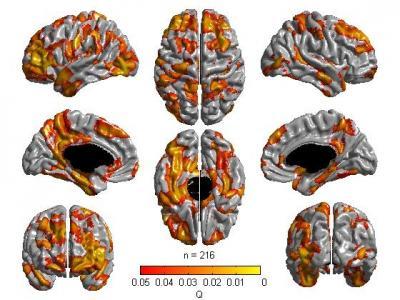
A collaborative study led by researchers at the Montreal Neurological Institute (MNI), McGill University has demonstrated a positive link between cognitive ability and cortical thickness in the brains of healthy 6 to 18 year olds. The correlation is evident in regions that integrate information from different parts of the brain.

Areas in the brain where there is an association between general cognitive ability and cortical thickness. (Credit: Montreal Neurological Institute)
The imaging study published this week in a special issue of scientific journal Intelligence is the largest and most comprehensive of its kind with a representative sample of healthy children and adolescents.
This study stems from the NIH MRI Study of Normal Brain Development, for which the MNI was the data coordinating centre. The database contains MRI scans and other data on the structure and function of the developing brains. More than 500 children and adolescents from newborns to 18-year-olds had brain scans multiple times over a period of years as well as intelligence, neuropsychological, verbal, non-verbal and behavioural tests. This information is now contained within the database allowing scientists to study how normal developmental changes in brain anatomy relate to motor and behavioural skills, such as motor coordination and language acquisition. Even higher-order skills like planning, IQ, and organizational skills can be assessed.
Previous studies have shown that intelligence and cognitive ability are correlated with regional brain structure and function. The association between regional cortical thickness and intelligence has been little studied and most previous studies of normal children had a relatively small sample. So with improvements in MRI-based quantification of cortical thickness and a much larger sample, researchers aimed to examine this relationship and to further characterize and identify brain areas where cortical thickness was associated with cognitive performance.
Cortical thickness may in part reflect the amount of complex connections between nerve cells. In other words, thicker cortices are likely to have more complex connections with consequences on cognitive ability. A positive link between cortical thickness and cognitive ability was detected in many areas of the frontal, parietal, temporal and occipital lobes. The regions with the greatest relationship were the 'multi-modal association' areas, where information converges from various regions of the brain for processing.
"A principal finding of this study is that it supports a distributed model of intelligence where multiple areas of the brain are involved with cognitive ability difference instead of the view that there is just one centre or structure important for intelligence differences in the brain," says Dr. Sherif Karama, psychiatrist at the MNI and co-investigator in the study. "Previous studies have shown a link between intelligence differences and individual brain structure or function. This is the first time that a correlation between a general cognitive ability factor and essentially most, if not all, cortical association areas is demonstrated in the same study."
A deeper insight into normal cognitive functioning and abilities is an important first step in the understanding of cognitive decline observed in the elderly as well as in those with various pathologies ranging from multiple sclerosis to schizophrenia, depression and mental retardation. Such an understanding may eventually lead to interventions that may be able to prevent or alleviate the decline or complications in cognitive function.
The project was funded by National Institute of Child Health and Human Development, the National Institute on Drug Abuse, the National Institute of Mental Health, and the National Institute of Neurological Disorders and the Fonds de Recherché en Santé du Quebec (FRSQ).

Source:
McGill University. "When It Comes To Intelligence, Size Matters." 

dimarts, 15 de febrer del 2011

Neurobiology of Violence: Adrian Raine talks (4 talk-playlist)

Neuroethical and Neurolegal Implications // An examination of the brain basis to crime and violence // What we can do to prevent future crime and the neuroethical implications


Adrian Raine
Chair, Department of Criminology, University of Pennsylvania
Richard Perry University Professor, Departments of Criminology, Psychiatry, and Psychology, University of Pennsylvania


"My main area of interest is Neurocriminology – an emerging sub-discipline of Criminology which applies neuroscience techniques to probe the causes and cures of crime. My laboratory focus on risk and protective factors for childhood conduct disorder, reactive and proactive aggression, adult antisocial personality disorder, homicide, and psychopathy. Our clinical neuroscience research program encompasses adults, adolescents, children, and toddlers, and we have interests in both male and female antisocial behavior. Techniques we use in our research include structural and functional brain imaging, autonomic and central nervous system psychophysiology, neuroendocrinology, neuropsychology, and x-ray fluorescence. We take a biosocial perspective to our investigation of antisocial behavior in which our end-goal is to integrate social, psychological, and environmental processes with neurobiological approaches to better understand antisocial behavior. We are also interested in other clinical disorders including schizotypal personality, hyperactivity, oppositional defiant disorder, alcohol and drug abuse, depression, PTSD, and anxiety which are comorbid with antisocial behavior."

dilluns, 14 de febrer del 2011

Redes 83: Las decisiones son inconscientes


¿Somos libres cuando decidimos? ¿Qué margen tiene el libre albedrío ahora que la neurociencia desvela cada vez más el gran poder del inconsciente?
Ya hay máquinas para ver cómo decide el cerebro y los primeros resultados muestran que, antes de entrar en la conciencia, muchas decisiones ya están tomadas por complejas redes cerebrales.

Desde Berlín, John-Dylan Haynes nos habla hoy en Redes de sus experimentos para descifrar la actividad cerebral que se esconde detrás de nuestros estados mentales.

dissabte, 5 de febrer del 2011

"Brain Story" attempts to answer the question “What is my mind and who am I?” We talk to philosophers, clinicians, neurosurgeons and their patients to discover quite what a finely balanced and complex machine the brain is (subtitulado)


Why do we think and feel as we do? For years man has sought to understand the workings of the mind. Now, with advances in modern-day technology and developments in neuroscience, a whole new world of brain research is opening up.

Understanding our minds is becoming a reality. Guided by top neuroscientist Susan Greenfield, Brain Story attempts to answer the question “What is my mind and who am I?” We talk to philosophers, clinicians, neurosurgeons and their patients to discover quite what a finely balanced and complex machine the brain is.

Watch the full documentary now

Susan Greenfield explains why she believes all aspects of human experience will eventually be explained in terms of the physical processes of the brain. The story of how we have gradually come to understand the astonishing complexity of the brain is revealed, from the earliest crude studies of the effects of brain injury, through to the latest insights from direct stimulation of specific areas in patients undergoing brain surgery whilst wide awake. Is it possible that our most spiritual feelings are merely the result of electrical activity in the temporal lobe?

I. All in the Mind
Where do emotions come from? Why do they feel so different from thoughts? Susan Greenfield looks at some of the old attempts to explain emotion in terms of brain areas and explains why she believes the answer must lie in the biochemistry of the brain – all the hundreds of chemical neurotransmitters which bathe the nerves.

II. In the Heat of the Moment
The illusion of vision. It feels as though we open our eyes and just see what’s out there, but the more we learn about the brain’s visual system, the further it seems this is from the truth. Patients who can’t see movement or recognize faces, reveal the tricks and short cuts the brain uses to construct an illusion of reality. Is the brain making up so much of what we think we’re seeing that vision is really just dreaming with your eyes open?

III. The Mind’s Eye
What is it about brains that has put us in charge of the planet? Were have humans’ unique linguistic abilities come from? Are there special structures in our brains which no other animals possess? Or is it possible that our sophisticated rich cultures are merely the result of having larger brains? Susan Greenfield explains why she believes we are truly just big-brained chimps.

IV. First Among Equals
The changes in the brain during the growth and development of a baby into an adult are explored. Susan Greenfield looks at how little of the fine structure of our brains is predetermined at birth, how the connections between nerves are constantly changing in response to what we encounter in the outside world. She explains her view that learning, memory and even the process of becoming a unique individual, should all be seen as a restless brain adapting minute by minute to the environment it encounters. Life is about how the world leaves its mark on us.

V. Growing the Mind
How do our brains generate consciousness? We take it for granted that the brain makes being alive feel the way it does, but there’s no reason why it should.The brain is made of the same biological ingredients as the rest of the body, and yet somehow it manages to generate the indescribable phenomenon of consciousness. Consciousness is far more than just being able to imagine; it’s a whole extra dimension. Susan Greenfield explains why she believes that the existence of a private world of experiences and feelings, is actually more extraordinary than the fact that living things evolved at all. She explores how we are finally taking the first steps towards understanding this tantalising paradox, and the implications for our view of ourselves as something more than complex machines.

VI. The Final Mystery

dilluns, 8 de novembre del 2010

Antonio Damasio: This Time With Feeling


Antonio Damasio, noted researcher and professor of neuroscience at USC, talks with The New York Times' David Brooks about emotions and the science of being human. He describes the difference between emotions and feelings, and explains why emotions are one of humanity's most important survival mechanisms.


Partner: Aspen Institute // Event Date: 07.04.09 // Speakers: David Brooks, Antonio Damasio

Antonio Damasio
Antonio Damasio is David Dornsife Professor of Neuroscience and Director of the Brain and Creativity Institute at the University of Southern California; he is also an adjunct professor at the Salk Institute. Damasio has made seminal contributions to the understanding of how the brain processes memory, language, emotions, and decisions. He has written several best-selling books, including Looking for Spinoza: Joy, Sorrow, and the Feeling Brain (Harcourt Trade Publishers, 2003) and Descartes’ Error: Emotion, Reason and the Human Brain (G.P. Putnam's Sons, 1994). Damasio has received many awards, including the 2005 Asturias Prize in Science and Technology and the 2004 Signoret Prize. Damasio is a member of the Institute of Medicine of the National Academy of Sciences and a fellow of the American Academy of Arts and Sciences.

divendres, 5 de novembre del 2010

Social Intelligence: Daniel Goleman discusses his book "Social Intelligence: The New Science of Human Relationships"

For more from Daniel Goleman, visit http://www.morethansound.net. This event took place on August 3, 2007 at Google headquarters in Mountain View, CA.


dimarts, 17 d’agost del 2010

Redes 373: Paul Ekman sobre las expresiones humanas y las emociones

Parte 1


Parte 2


Ekman desarrolló una lista de emociones básicas a partir de investigaciones transculturales en individuos destacados de la tribu de Papúa Nueva Guinea. Observó que los miembros de una cultura aislada de la Edad de Piedra son capaces de identificar con un alto grado de confiabilidad las expresiones emocionales al observar las fotografías tomadas a personas de culturas con las que ellos no han estado familiarizados.
También eran capaces de adjudicar ciertas expresiones faciales a las descripciones de situaciones específicas. Con esa información, llegó a la conclusión de que algunas expresiones son básicas, o biológicamente universales, en la especie humana. La siguiente es la lista elaborada por Ekman (1972) de las emociones humanas:
repugnancia
felicidad
ira
miedo
sorpresa
tristeza
Sin embargo, en la década de 1990 Ekman amplió esta lista de expresiones básicas a quince, e incluyó un rango más extenso de expresiones positivas (Ekman, 1999).
________________

Cuando hablamos de sentimientos, de emociones, casi nunca pensamos en la ciencia. De hecho, hasta hace poco la ciencia renegaba de ?lo sentimental? y su estudio se relegaba a la poesía. Pero esta situación ha cambiado y antropólogos, psicólogos, neurocientíficos e incluso investigadores de inteligencia artificial se han sumado al estudio de las emociones aportando nuevas piezas con las que completar el rompecabezas.

Cuando nos quedamos en blanco ante un examen, cuando nos ruborizamos frente a una persona que nos gusta?todos en más de una ocasión hubiésemos querido no emocionarnos y actuar de forma más racional. Por ello es inevitable preguntarse: ¿para qué sirven las emociones? ¿por qué nos emocionamos cuando lo hacemos? ¿qué desencadena las emociones? ¿podemos controlarlas para, por ejemplo, evitar emocionarnos en situaciones destructivas?

La ciencia nos dice que las emociones son mecanismos cerebrales seleccionados para ayudarnos a sobrevivir y que sería muy difícil explicar la evolución humana al margen de las emociones. En esta edición de REDES daremos un paseo por la ciencia de la emoción en compañía de Paul Ekman, uno de los mayores expertos del mundo en cómo expresamos nuestros sentimientos. Con él debatiremos sobre los tres tipos principales de emociones que nos gobiernan: las básicas, que son innatas y universales, las superiores, como el amor, y las que se desarrollan y manifiestan en determinadas culturas. Además, explicaremos cómo se forma en nuestro cerebro la ?base de datos? emocional que determina cómo nos comportamos y analizaremos las expresiones faciales de las distintas emociones y sus aplicaciones en nuestra vida cotidiana, o los patrones de expresión que se usan en animación para expresar las emociones de los personajes.

On Human Face, Emotions and Human Communication: Conversation with Paul Ekman


Psychologist Paul Ekman joins Harry Kreisler to talk about his scientific work on the human face. They discuss what is now known about the role of the face in human emotions and the implications of these insights for human communication, self understanding and national security.

Series: "Conversations with History" // 4/2004 // Public Affairs // Humanities // Show ID: 8637

________________________________

From Wikipedia (http://en.wikipedia.org/wiki/Paul_Ekman)

Ekman's work on facial expressions had its starting point in the work of psychologist Silvan Tomkins. Ekman showed that contrary to the belief of some anthropologists including Margaret Mead, facial expressions of emotion are not culturally determined, but universal across human cultures and thus biological in origin. Expressions he found to be universal included those indicating anger, disgust, fear, joy, sadness, and surprise. Findings on contempt are less clear, though there is at least some preliminary evidence that this emotion and its expression are universally recognized.
In a research project along with Dr. Maureen O'Sullivan, called the Wizards Project (previously named the Diogenes Project), Ekman reported on facial "microexpressions" which could be used to assist in lie detection. After testing a total of 20,000 people[6] from all walks of life, he found only 50 people that had the ability to spot deception without any formal training. These naturals are also known as "Truth Wizards", or wizards of deception detection from demeanor.[7]
He developed the Facial Action Coding System (FACS) to taxonomize every conceivable human facial expression. Ekman conducted and published research on a wide variety of topics in the general area of non-verbal behavior. His work on lying, for example, was not limited to the face, but also to observation of the rest of the body.

dijous, 17 de juny del 2010

Antonio Damasio "Brain and mind: from medicine to society" - Neuroscience and Psicology


Conferència "Brain and mind: from medicine to society", a càrrec d'Antonio Damasio, catedràtic de Neurociència i de Psicologia i premi Príncep d'Astúries de Ciències l'any 2005.

Acte organitzat per la UOC i per la Conselleria de Salut del Govern de la Generalitat.
24 de maig de 2007, auditori del Parc de Recerca Biomèdica de Barcelona.


Research Topics

The neurobiology of mind and behavior, with an emphasis on emotion, decision-making, memory, communication, and creativity.
Research Overview
Antonio Damasio is an internationally recognized leader in neuroscience. His research has helped to elucidate the neural basis for the emotions and has shown that emotions play a central role in social cognition and decision-making. His work has also had a major influence on current understanding of the neural systems, which underlie memory, language and consciousness. Damasio directs the newly created USC Brain and Creativity Institute.
Source and more info: http://www.usc.edu/programs/neuroscience/faculty/profile.php?fid=27

dimarts, 8 de juny del 2010

Neuroplasticity: "The Brain that Changes Itself". Norman Doidge, M.D., psychiatrist and psychoanalyst

"The discovery of neuroplasticity, that our thoughts can change the structure and function of our brains, even into old age, is the most important breakthrough in our understanding of the brain in four hundred years."

"It is a plastic, living organ that can actually change its own structure and function, even into old age. Arguably the most important breakthrough in neuroscience since scientists first sketched out the brain’s basic anatomy, this revolutionary discovery, called neuroplasticity, promises to overthrow the centuries-old notion that the brain is fixed and unchanging. The brain is not, as was thought, like a machine, or “hardwired” like a computer. Neuroplasticity not only gives hope to those with mental limitations, or what was thought to be incurable brain damage, but expands our understanding of the healthy brain and the resilience of human nature.

Norman Doidge, MD, a psychiatrist and researcher, set out to investigate neuroplasticity and met both the brilliant scientists championing it and the people whose lives they’ve transformed.

The result is this book, a riveting collection of case histories detailing the astonishing progress of people whose conditions had long been dismissed as hopeless. We see a woman born with half a brain that rewired itself to work as a whole, a woman labeled retarded who cured her deficits with brain exercises and now cures those of others, blind people learning to see, learning disorders cured, IQs raised, aging brains rejuvenated, painful phantom limbs erased, stroke patients recovering their faculties, children with cerebral palsy learning to move more gracefully, entrenched depression and anxiety disappearing, and lifelong character traits altered.

Doidge takes us into terrain that might seem fantastic. We learn that our thoughts can switch our genes on and off, altering our brain anatomy. Scientists have developed machines that can follow these physical changes in order to read people’s thoughts, allowing the paralyzed to control computers and electronics just by thinking. We learn how people of average intelligence can, with brain exercises, improve their cognition and perception in order to become savant calculators, develop muscle strength, or learn to play a musical instrument, simply by imagining doing so.

Using personal stories from the heart of this neuroplasticity revolution, Dr. Doidge explores the profound implications of the changing brain for understanding the mysteries of love, sexual attraction, taste, culture and education in an immensely moving, inspiring book that will permanently alter the way we look at human possibility and human nature.

Dr. Norman Doidge introduces principles we can all use to overcome brain limitations and explores the profound brain implications of the changing brain in an immensely moving book that will permanently alter the way we look at human possibility and human nature."

Source: http://www.normandoidge.com/normandoidge/ABOUT_THE_BOOK.html


An interesting fragment:
"Plasticity requires that we re-examine culture, too. Most think the relationship between the brain and culture is a simple one: The human brain produces culture. In fact our culture also moulds our brains. Just as children with learning disorders can develop new processors, different cultures cultivate different kinds of brains, en masse. The Sea Gypsies, a tribe off the coast of Thailand, learn to see clearly underwater, diving 10 metres in their hunt for food — an example of a whole culture that has developed a super-sense.

As Richard Nisbett shows in The Geography of Thought, when Asians look at still life pictures they see the relationships between the objects very clearly, but the main object less clearly. Westerners see the opposite. These perceptual differences are not based on a difference of opinion about what to focus on, but on involuntary, unconscious brain processing wired into the subjects by their culture, and alterable by emigration. Thus many of the differences between cultures and civilizations need not be seen as based on either genetic (biological) or 240603_f260experiential differences. Cultural experience shapes biology, and no doubt biology shapes cultural experience. These discoveries promise to reshape, in the most profound way, our understanding of cultural acquisition, conflicts, immigration tensions and even the rates at which we, in a globalized world, can expect each other to change."

divendres, 28 de maig del 2010

What is REALLY the "unconcious"? Wat makes us act as we do? Interview with John A. Bargh

His lines of research all focus on unconscious mechanisms that underlie social perception, evaluation and preferences, and motivation and goal pursuit in realistic and complex social environments. That each of these basic psychological phenomena occur without the person's intention and awareness, yet have such strong effects on the person's decisions and behavior, has considerable implications for philosophical matters such as free will, and the nature and purpose of consciousness itself.


"We discovered a new vein of research — the relation between physical and social or psychological concepts — that we came to by taking evolutionary principles seriously and applying them to psychology. We weren't using evolutionary psychology, which has largely been focused on mating and reproduction. Our focus, rather, was in terms of evolutionary biology and the basic principles of natural selection: and that field makes clear that humans must have had these kinds of mechanisms or these processes to guide our behavior prior to evolution or emergence of consciousness."

Who is John A. Bargh?

Professor of social psychology at Yale University and director of the ACME (Automaticity in Cognition, Motivation and Evaluation) Lab. In 2007 he received the Donald T. Campbell Award from the Society for Personality and Social Psychology for distinguished contributions to social psychology, and later that year received the Scientific Impact Award from the Society for Experimental Social Psychology.
http://www.edge.org/3rd_culture/bios/bargh.html

Full Interview and transcript:
http://www.edge.org/3rd_culture/bargh09/bargh09_index.html

dimarts, 25 de maig del 2010

Redes 40: Educación emocional desde el útero materno

¿Somos conscientes de que el estrés de la madre llega hasta su bebé y tendrá consecuencias en el desarrollo emocional y psíquico del niño (p.e. síndrome del déficit de atención o su coeficiente intelectual)?


Nueve meses de embarazo con controles regulares a la madre y al feto… pero ¿alguien tiene en cuenta el estado emocional de la embarazada? ¿Somos conscientes de que el estrés de la madre llega hasta su bebé? Eduardo Punset descubre, de la mano de la investigadora en psicobiología perinatal del Imperial College London, Vivette Glover, la estrecha relación entre las emociones y la vida en el útero materno.

http://www.redesparalaciencia.com/1292/redes/2009/redes40-educacion-emocional-desde-el-utero-materno

dijous, 29 d’abril del 2010

EPIGENETICS: The Ghost in your Genes - BBC Horizon


The Ghost in your Genes // BBC Horizon

Biology stands on the brink of a shift in the understanding of inheritance. The discovery of epigenetics hidden influences upon the genes could affect every aspect of our lives.
At the heart of this new field is a simple but contentious idea that genes have a 'memory'. That the lives of your grandparents the air they breathed, the food they ate, even the things they saw can directly affect you, decades later, despite your never experiencing these things yourself. And that what you do in your lifetime could in turn affect your grandchildren.
The conventional view is that DNA carries all our heritable information and that nothing an individual does in their lifetime will be biologically passed to their children. To many scientists, epigenetics amounts to a heresy, calling into question the accepted view of the DNA sequence a cornerstone on which modern biology sits.
Epigenetics adds a whole new layer to genes beyond the DNA. It proposes a control system of 'switches' that turn genes on or off and suggests that things people experience, like nutrition and stress, can control these switches and cause heritable effects in humans.

Source
http://www.bbc.co.uk/sn/tvradio/programmes/horizon/ghostgenes.shtml

dilluns, 26 d’abril del 2010

Redes 57: Cambiar el cerebro para cambiar el mundo


Redes 57: “Cambiar el cerebro para cambiar el mundo” // Fechas de emisión: 25 y 28/04/10

Estamos programados, más que cualquier otro animal, para cambiar, para aprender y para dejar que nuestro entorno moldee el sustrato de nuestros pensamientos: el cerebro. Si queremos mejorar nuestro comportamiento con los demás y con nuestro entorno natural habrá que trabajar en ello desde los primeros años, como hacemos para aprender a hablar o a tocar un instrumento. Hoy en Redes escucharemos propuestas del neuropsicólogo Richard Davidson para mejorar la educación y con el psicólogo Daniel Goleman descubriremos cómo consumir en el futuro para ser unos mejores huéspedes de este planeta.
Fuente:

Neuroscientist Richard Davidson presents his research on how social and emotional learning can affect the brain

The Heart-Brain Connection: The Neuroscience of Social, Emotional, and Academic Learning – Neuroscientist Richard Davidson presents his research on how social and emotional learning can affect the brain.


“The brain is plastic, built to change in response of experience.”
“Plasticity occurs all our lifes.”
“The preftrontal cortex is key and is aconvergence zone for affect and cognition: negative emotion will interfere with cognitive prefrontal function.”
“Social-emotional learning is an empirically verified strategy to improve skills of emotions regulation and social adaptation.”
“As such, social-emotional learning likely produces beneficial brain changes.”
“Education literally shapes the child’s brain and likely produces alterations that lay the foundations for all future learning, emotion regulation and social functioning.”

dilluns, 19 d’abril del 2010

Redes 56: “Mentes conectadas sin brujería”


Redes 56: “Mentes conectadas sin brujería” // 18 y 21/04/10

Desde cómo aprendemos a hablar, a escribir o a conducir, hasta por qué se revuelve nuestro interior cuando vemos el sufrimiento de otra persona… siempre están detrás las neuronas espejo, uno de los grandes descubrimientos de las últimas dos décadas. Podríamos verlas como una red invisible que une a todos los seres humanos entre ellos y con sus predecesores, al permitir la conexión entre las mentes y la transmisión de conocimiento y cultura mediante el aprendizaje. Junto al neurocientífico Marco Iacoboni, de la Universidad de California, Eduardo Punset repasará los fantásticos poderes de las neuronas espejo.

Más información:

http://www.redesparalaciencia.com/2644/redes/2010/redes-56-mentes-conectadas-sin-brujeria

dijous, 8 d’abril del 2010

"Viso e carattere. Iniziazione alla morfopsicologia" Per Louis Corman (Google Books)

In italiano, il libro dal fondatore della disciplina de la Morfopsicologia, Louis Corman.

Viso e carattere. Iniziazione alla morfopsicologia

Louis Corman

Edizioni Mediterranee, 2003
ISBN 882721514X, 9788827215142
296 pagine